

From the passage to a world of books
Vienna’s city centre can be explored by more than a succession of squares. You can follow its spaces, too: from an open street into an arcade, on to a palace façade and finally into a hall full of books. This walk begins at Palais Ferstel and ends at Josefsplatz. The scale changes repeatedly along the way, which is part of its appeal. The idea is less to see as many sights as possible than to experience the shifts between outside and inside, everyday life and grandeur, passing through and choosing to stay.
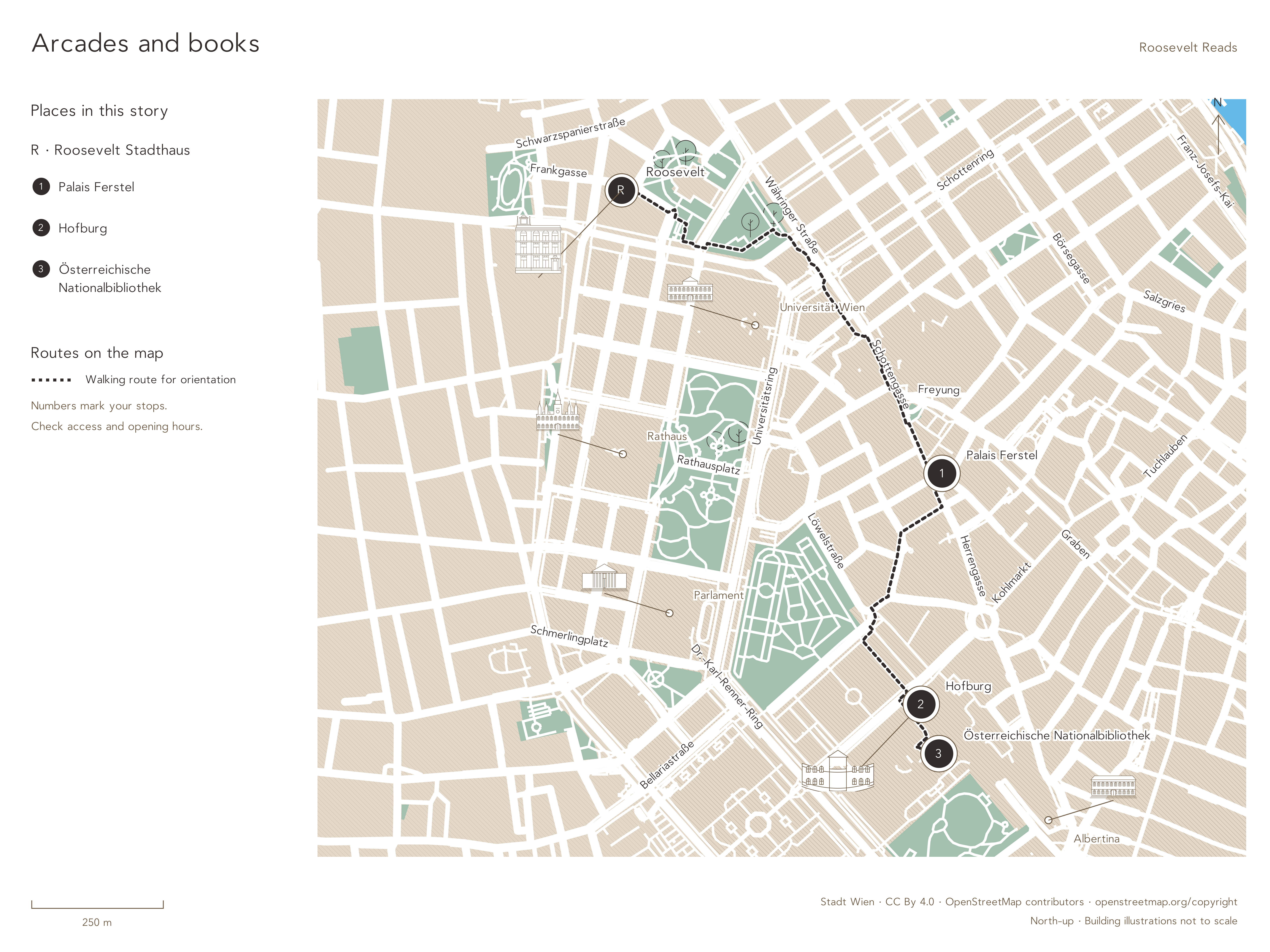
From the Roosevelt, the first part of the walk leads towards Freyung. Palais Ferstel lies between Freyung, Herrengasse and Strauchgasse; its arcade is an appealing way to experience this part of the city. Look at the architecture as more than a backdrop for shops or a coffee. Notice how a passage develops its own rhythm: an entrance, a narrower section, a glance upwards, a new exit. The arcade is not a public park. Whether and how it can be entered depends on the circumstances on site.
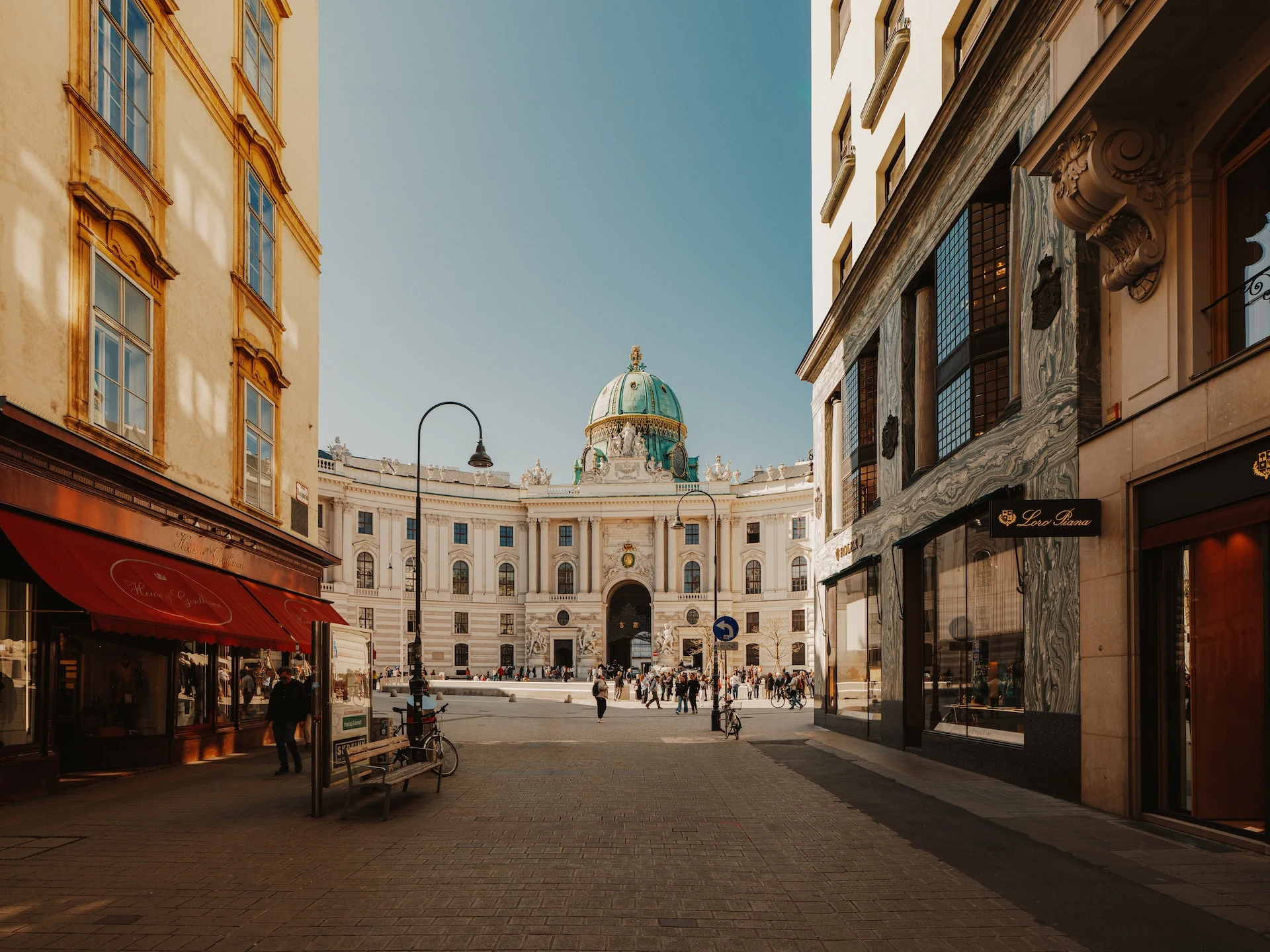
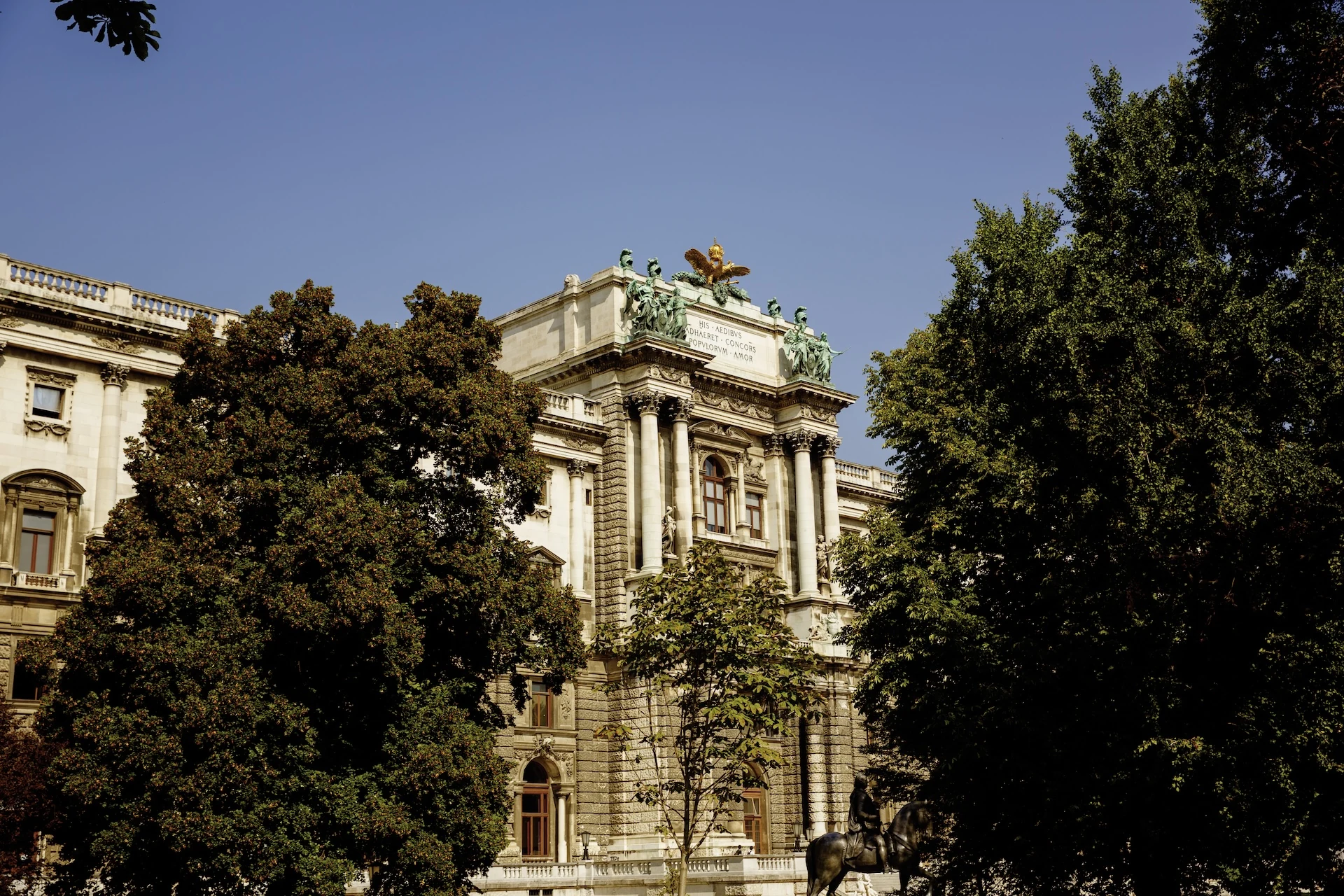
Herrengasse then provides a natural route to Michaelerplatz. Leave room for small observations along the way: the depth of a carriage entrance, the shape of a window, the transition between two façades. Reading a city this way requires no exhaustive list of important buildings. The differences become the subject themselves. At Michaelerplatz, the view opens towards the Hofburg. Let the walk slow down again here before continuing to Josefsplatz. The grand façades give the route a different, more ceremonial tone.
The State Hall of the Austrian National Library is the main destination. It was built in the 18th century as part of the former Court Library. Its dimensions are impressive: around 80 metres long and 20 metres high. Between the bookcases, dome and historic globes, knowledge takes shape as an architectural space. You do not come here to browse the shelves for a holiday book. This is a visit to a historic library hall and its architecture. That distinction makes it a particularly rewarding addition to a walk through the city centre.
In the hall, take time first to absorb the overall impression. Then choose individual details rather than trying to take everything in at once. Which lines give the space its order? Where does your gaze travel? How do the proportions change when you move? These questions are interesting even without a background in art history. The library puts the number of books in the State Hall at around 200,000. The figure conveys the scale of the collection; in person, it may be the relationship between space, light and materials that stays with you most.
Check the State Hall’s opening arrangements in advance, as events can affect visits. Plan it as a stop in its own right, rather than somewhere to pass through casually. Afterwards, a quiet walk back through the city centre is often enough. You may now notice how different a bright square feels after a large interior. This is the idea of the route: to discover Vienna through its sequence of spaces, as well as through names and dates. The map connects the stops; the pauses between them are yours to choose.
At a glance
Freyung and Palais Ferstel → Michaelerplatz and Hofburg → Josefsplatz. The State Hall is a separate museum visit. Check access to the arcade and current visiting hours for the State Hall.
For your visit: Palais Ferstel · State Hall.
Discover more: Discover Vienna · More Roosevelt Reads.


